My Reputation Score: What Is It and Why Does It Matter?
Are you wondering, “What’s my reputation score?” Learn about your reputation score, get more positive reviews, and encourage customer feedback with our help.
Are you wondering what your current digital reputation score is and how you can improve it?
Your personal or business reputation score illustrates how well you stand out from the crowd and how the public perceives your online presence.
Negative reviews affect how potential customers perceive your business and your overall reputation score. On the other hand, if you have a system in place for managing online reviews, you have a better chance of garnering positive reviews that will raise your online status.
In this article, we discuss how your brand’s digital reputation score influences your business performance, along with tips for improving it with an ORM company.
For a free online reputation analysis and to learn about your reputation score, submit your details and we will be in touch.
What Is the Meaning of a Reputation Score?
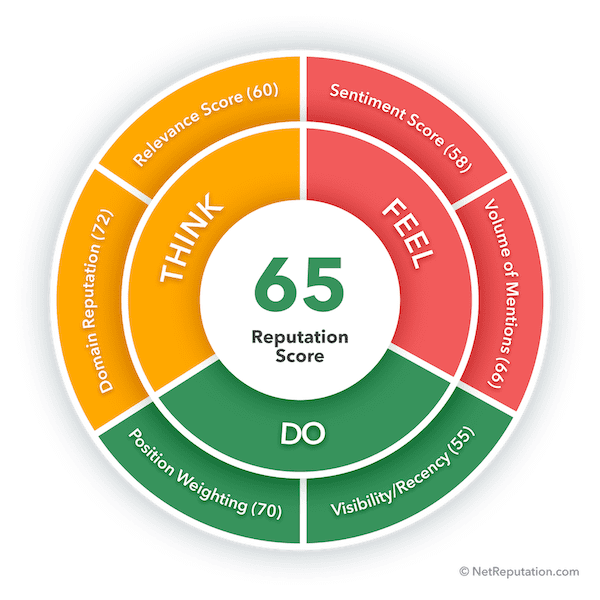
Your personal or corporate reputation score represents the total value of your online footprint and weighs the positives and negatives. Once we have this information, we can develop a strategic plan to address the negatives and improve your overall online reputation score.
Your score is based on several factors. These include the sum of positive, negative, and neutral details that show up in Google Search pages (SERPs) and other online search results, plus how they rank when people search for you online.
In other words, your brand’s score indicates what people see and think about you after searching for your company’s reputation online.
A positive reputation is reflected by a business’s reputation score, and managing this well is essential. Your digital footprint can affect many aspects of your life, both professionally and personally.
The world has become increasingly digitized, and social media platforms are now an integral part of our personal lives. With all of this in mind, your reputation score has never been more important.
We can help you create a positive digital presence, even if you’re starting from zero or rebounding from reputational damage. Call us at 941-259-4554 for more information about improving customer sentiment.
Why Does Your Score Matter?
Like it or not, how you look online matters for the customer experience and business performance. No matter who you are or what you do, people are searching for you on the web.
And when they do, they judge your character and credentials based on what shows up in search results, including your business listings on review sites and negative reviews.
When your score is high, people are more likely to find online assets that portray a positive image. In this case, your brand is more likely to earn people’s trust and pave the way to success.
But if your score is low, chances are good that employers, landlords, clients, and friends are finding things that reflect poorly on your image.
It’s no secret that negative information undermines how you are perceived in the digital environment. If negative information is easy to find in search results, others may not extend job offers, continue building relationships with you, or trust your company enough to buy from it.
In these cases, your online presence is likely hurting relationships, destroying opportunities, and making it harder to realize your full potential.
Our clients come to us when they need to build or repair their internet reputation and take control of their digital presence. Call us at 941-259-4554 to learn more.
Who Is Searching for You Online?

People from all walks of life search for your personal brand or company online every day. These include:
- Hiring Managers – More than 70% of hiring managers screen your social media accounts during the hiring process.
- Employers – 4 out of 10 employers monitor you on social media at some point in your tenure.
- Job Prospects – Nearly 60% of job seekers research your business online before that first interview.
- Customers – 86% of prospects comb through review sites before visiting a local company.
- College Admissions – Many colleges will now deny or rescind admission due to inappropriate digital content.
- First Dates – Almost 40% of people perform online research before their first encounter.
- Friends and Relatives – A recent survey found that 42% of people have changed their opinion of a friend or colleague because of negative online information.
Get a free reputation score scan today or speak with one of our ORM experts by calling 941-259-4554.
Who Creates My Reputation Score?
Numerous companies offer to assess your online presence and create a comprehensive score based on the quality and size of your digital presence.
Each site uses its own criteria and reputation score scale to measure your reputation. They use their findings to create a value representing your online image. As such, each website may have different results once you’ve asked them to evaluate your digital presence.
One of the more notable sites for this is MyLife, which collects various elements of your presence and calculates your MyLife Reputation Score on a 1-5 scale, with 1 being the lowest and 5 the highest.
What Is My Personal Score Based On?

Your reputation score is based on how other people perceive you. It’s calculated by analyzing the frequency and quality of your online reviews and ratings, which help evaluate your star rating and review volume, compared to those of others in your industry. The higher your reputation score, the better people think you are.
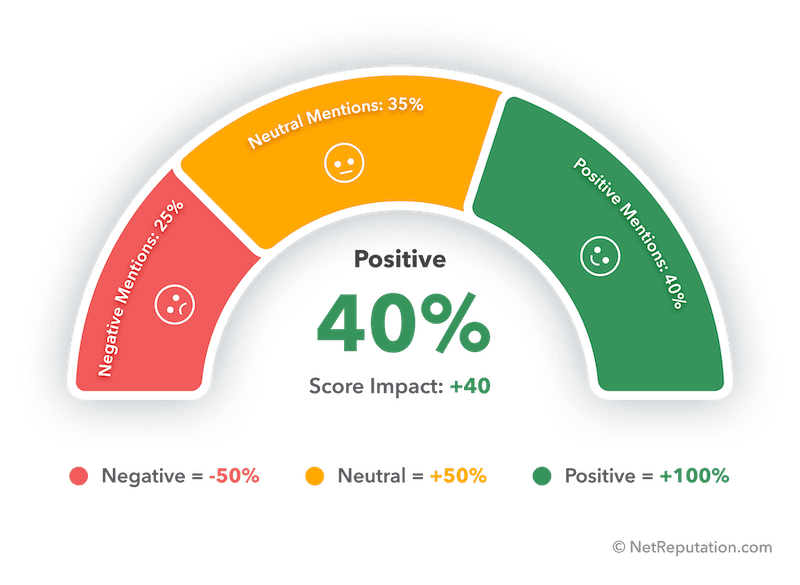
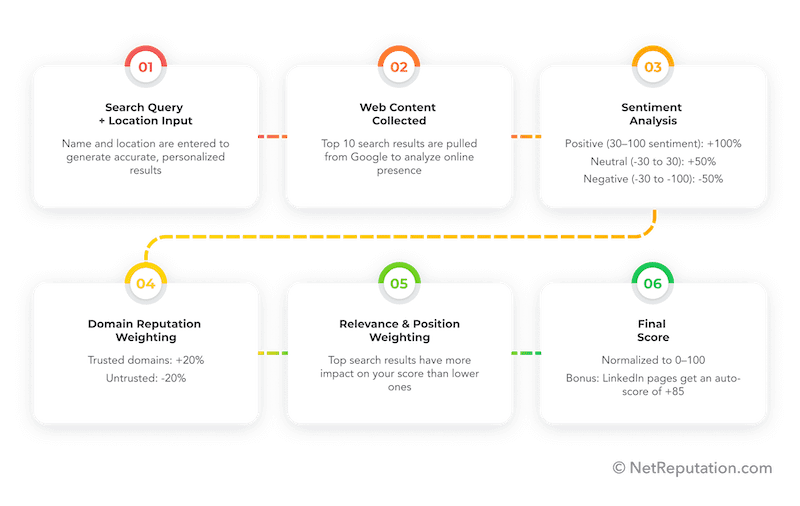
Sites like MyLife base your personal Google reputation score on any number of online assets and criteria. But while companies each have a unique way to calculate your score, most use a variety of data. These data points often include mentions of your name, the quality of each item, each item’s search ranking, level of engagement, and sentiment analysis classifying consumer feedback as positive, negative, or neutral. In some score calculations, positive mentions may be given a weight of 100%.
A complete personal ORM analysis digs deep to identify all mentions of your name in search results. It then carefully evaluates those listings to determine how much each result affects your online footprint. This includes where and how often searchers interact with each page.
With each item identified and analyzed, your customized internet reputation analysis produces a net reputation score. This score indicates the overall quality of your online image.
Your personal score provides a brief but powerful glimpse into how you’re perceived online.
What Is a Positive MyLife Reputation Score?
A good reputation score varies depending on who analyzes your online presence. For example, while 4.3 may be a good score on MyLife.com, 600 might be a high score on another reputation services site.
But no matter where it comes from, a good score typically shows a clean, consistent presence on Google’s first page. That matters because 72% of consumers trust businesses with positive testimonials, and companies with 4.0-4.5 star ratings earn 28% more revenue. Positive SERP rankings help highlight your best qualities whenever a friend, boss, or coworker searches your name online.
What Is a Poor Score?
Much like their “good” counterparts, a poor score can vary widely depending on the scoring service.
While scores of 1 and 2 may indicate a poor reputation on sites like MyLife, scores in the 0-100 or 0-30 ranges can indicate poor performance on other sites.
Overall, a bad score likely indicates the presence of one or more negative items in Google Search. These often include negative reviews, comments, and articles that damage your reputation and dominate your search engine presence.
Even one negative item is often all it takes to hurt your opportunities and drag your personal reputation score through the mud.
What Is the Impact of a Low Reputation Score?

A low reputation score reflects your personal reputation based on how the result was obtained, and several factors affect it, including how quickly and consistently you respond to feedback. Factors that generally pull your score down include the presence of negative articles, comments, images, and reviews, plus where each one ranks in Google and how often searchers interact with each negative link. The worse these items are, the lower your score will be.
While the impact varies by brand, factors like bad reviews, news articles, unflattering images, and your response rate tend to hurt your score and shape customer perceptions of engagement the most.
Sometimes, a polite removal request is all it takes to delete an unwanted comment, article, or blog from the web.
But removing items like negative reviews and news articles is often extremely difficult. This is because most sites have strict procedures for removing such content. In this case, a custom personal ORM campaign may be your best option.
Ongoing monitoring of your online presence is essential for effective ORM. It’s also essential for ensuring your internet reputation score moves in the right direction and for making sure your business information is accurate across all online listings, so preventable score declines don’t occur.
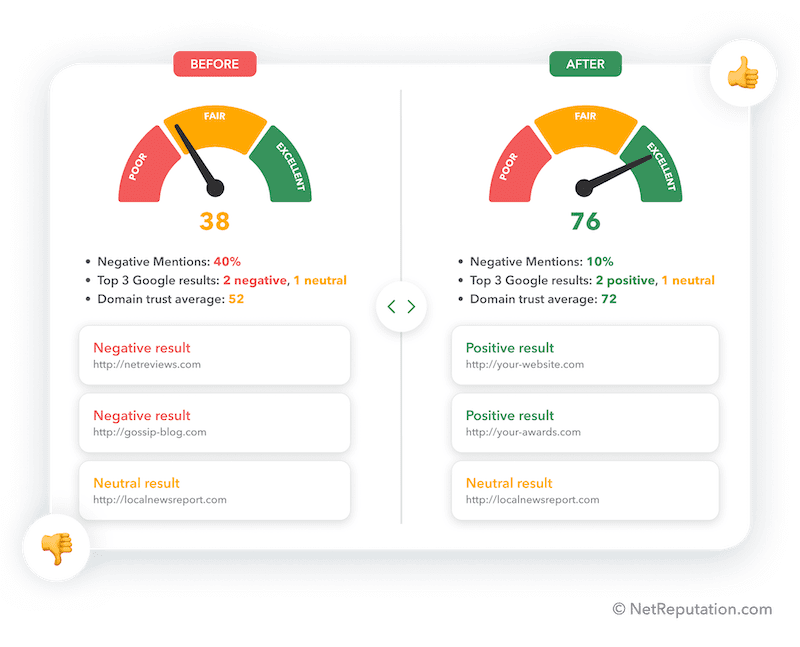
The decline in negative links from Google Search, combined with the rise in positive mentions, is a good sign that your reputation score is improving.
What Is My Reputation Score?
Your personal score is calculated based on the quality of your Google search results. Because so few Googlers go beyond the first page, it’s your first 10 listings that factor most into your personal score. If you want to know what your reputation score will be, start by searching for yourself.
Then, make a note of each listing related to your personal online brand image and business listings on the first 2-3 pages. Also, note that second-page results may someday move up and reach page one.
Determine how these results reflect on your name (positive, negative, and neutral) and how high each ranks in search.
Stronger online visibility usually means a bigger impact on your personal reputation score.
A brief personal analysis will help set your expectations. It will also help you gather reputation data, turn it into actionable insights, alert you to potential problems, and show how much you may need personal online reputation management.
Why Is My Reputation Score So Low?
Are you suffering from a low reputation score? If you see anything that needs updating, go ahead and do so immediately, and double-check your social media profiles and any other sites you’re on, like Facebook or X (if you have one). Your brand’s online reputation score may be suffering because of:
- Poor Social Media Management: Whether you share a questionable video or let a comment thread get away from you, a poorly managed social media presence can quickly become your worst digital nightmare.
- Bad Online Reviews: If you’re a small business owner or local professional, a bad review can leave a lasting stain on your legacy and bottom line, and Google reviews are often a key source that can drag the score down.
- Unflattering Court Records: A past mistake or court case could be throwing your personal reputation score behind bars.
- Negative Media Coverage: Even just one negative news item or blog can create a lifetime of bad press for your search engine presence.
- Inconsistent Profiles: Inconsistent information may seem innocent enough, but across different platforms, it can erode trust, hurt rankings, and damage your personal brand.
InternetReputation.com provides the information and services you need to protect your digital presence. Get started with a free online reputation analysis by calling 941-259-4554 today.
FAQ About Your Personal or Business Online Reputation Score

How is my online reputation score calculated?
Search engines use various sources, including names, page views, rankings, and sentiment analysis of customer feedback and reviews, to calculate your reputation score. This score reflects the overall quality of your online image and the effectiveness of your online communication.
Who is behind my reputation score?
Different online services assess and amplify your digital presence based on business or personal evaluations. A positive SERP rank shows how well your qualities are displayed when friends, bosses, or coworkers evaluate your reputation. The acceptable score varies depending on the evaluator.
Why do you need to know your reputation score?
Your reputation score is a key factor Google considers when ranking your website. It represents what people see and think about you when they search your name online, affecting trust, visibility, and decision-making. Knowing and improving this score is important.
Is it possible to fix a bad reputation score?
Fixing a poor reputation score can be challenging. Negative forum posts or blog posts may be removed with a simple request, but negative reviews and news articles are harder to remove due to strict site policies. Working with an online reputation management company is often the best way to improve your score over time.
Does a higher reputation score mean better opportunities?
Higher scores indicate credibility and trustworthiness, supporting career advancement and stronger professional opportunities. More people are likely to seek inspirational content from you, benefiting your personal brand.
How can I maximize my reputation score?
Maintaining a high SERP ranking shows that you or your business are in good standing online. To improve your score, keep your profile up to date, deliver exceptional service, share relevant content, and engage with the online community. A strong reputation attracts more customers.
What are the benefits of a good business reputation score?
A good reputation score builds user trust, leading to increased website visits, traffic, and sales. It also helps your website rank higher on search engine results pages.
Can technology help you build a good reputation?
Yes, technology can help build a good reputation by monitoring website performance and reputation, improving security, and protecting user data.
Is reputation a trend for SEO?
Yes, websites appearing near the top of search results are viewed more positively, making SEO a leading trend in online reputation management.
What is the cost of reputation management?
Costs vary based on your specific needs, including reputation analysis, monitoring, content removal, and creation. Services are tailored to your online reputation management requirements.
If your personal online reputation score needs improvement, we specialize in customized strategies to enhance your digital image and help you build the reputation score you deserve.
To Schedule Your Free Reputation Analysis, Call 941-259-4554 or Contact Us Today